


If you are wondering how long does it take to build a website, the realistic answer ranges anywhere from a single weekend using a DIY platform to four months with a traditional agency. For small business owners seeking professional web design in Kitchener Waterloo, long agency timelines can stall growth and delay lead generation. Fortunately, modern web design does not have to drag out over quarters. With a streamlined workflow, a complete custom site can launch in as little as 7 to 14 days without cutting corners on design or performance.
Key Takeaways of Small Business Website Timelines
- DIY Site Builders: 1 to 4 weeks, depending heavily on your free time and technical comfort.
- Traditional Web Agencies: 8 to 16 weeks due to multiple approval tiers, account managers, and bloated discovery phases.
- Set Freelance Packages: 7 to 14 days once project assets and onboarding are submitted.
- The #1 Delay Factor: Waiting on written copy, high-resolution photography, and client feedback.
- Google Visibility: Initial search indexing takes hours to weeks, while competitive local keyword rankings typically mature over 3 to 6 months.
How Long Does It Take to Build a Website? The Short Answer
A website can take a few days if you build it yourself or up to several months with an agency. For Kitchener Waterloo small businesses, an independent designer typically needs 1 to 3 weeks, while my dedicated sprint packages take exactly 7 or 14 days. The single biggest factor determining your launch date is how quickly your content and branding assets are ready.
Website Build Timelines by Method
The path you choose to build your website dictates the calendar. Whether you decide to wrestle with software yourself, hire an enterprise agency, or book an intensive sprint, here is how the timelines compare across the board:
| Build Method | Average Launch Timeline | Best For | Typical Bottlenecks |
| DIY Website Builder | 1 to 4+ weeks | Solo entrepreneurs with minimal budgets | Learning curve, layout frustration, mobile optimization |
| Pre-Made Template Customization | 1 to 2 weeks | Businesses needing a temporary placeholder | Rigid styling options, plugin conflicts, generic look |
| 1-Week Sprint Package | 7 business days | Local service trades and service businesses | Completing the initial onboarding checklist |
| 2-Week Sprint Package | 14 business days | Multi-service companies, studios, and custom setups | Coordinating multi-page copy and advanced setups |
| Custom Freelance Project | 3 to 6 weeks | Businesses needing complex external integrations | Scope creep, staggered revision rounds |
| Traditional Web Design Agency | 8 to 16 weeks | Large corporations with committee governance | Multiple management layers, scheduling delays, slow sign-offs |
How Long Does It Take to Build a Website? The 6 Stages
Every professional web project follows an essential sequence to ensure the final site looks great, loads quickly, and converts visitors into paying customers. Understanding these six stages helps explain where time is spent.
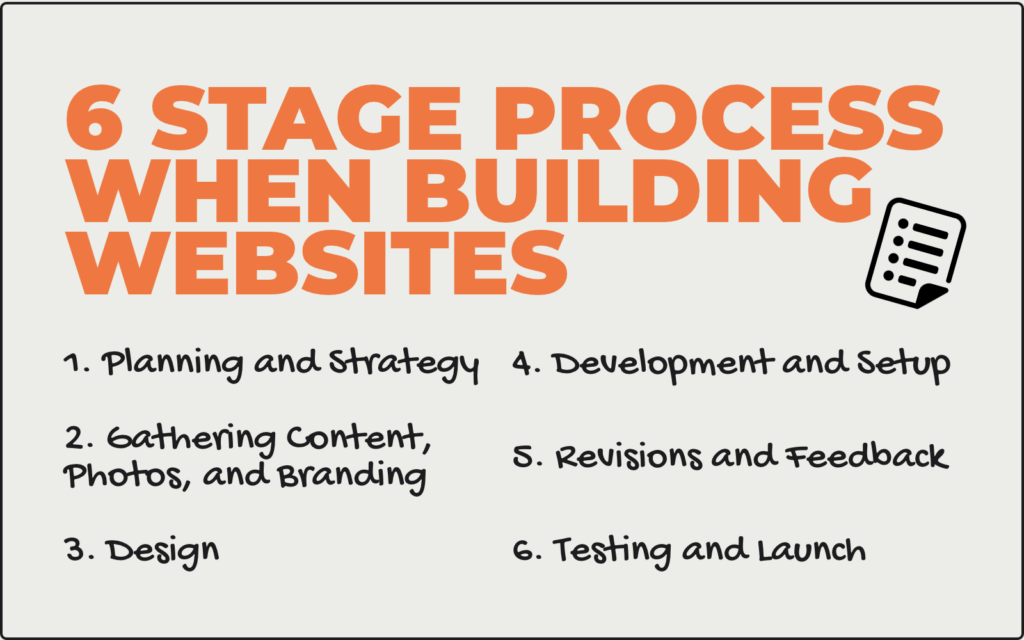
1. Planning and Strategy
Before touching a design canvas, you need a blueprint. This stage defines your site architecture, determines primary user journeys, maps call-to-action placements, and audits competitor positioning across Kitchener, Waterloo, and Cambridge. When done properly, this prevents costly mid-project redesigns.
2. Gathering Content, Photos, and Branding
This stage is the single largest variable in any website build. Writing clear service copy, organizing customer reviews, collecting staff bios, and rounding up high-resolution imagery takes deliberate effort. When assets are delivered upfront, the rest of the project moves at high speed.
3. Design
During the visual design phase, wireframes turn into polished layouts. Desktop and mobile viewports are crafted to reflect your brand identity, using cohesive typography, colour palettes, and balanced whitespace. Visual balance is prioritized alongside conversion-focused page structures.
4. Development and Setup
Once layouts are finalized, the site is constructed on the platform engine (such as Showit or WordPress). This step involves connecting domain records, configuring contact forms, linking calendar booking software, setting up on-page SEO meta tags, and establishing secure SSL certificates.
5. Revisions and Feedback
After the initial build is assembled, the site is reviewed against project goals. Consolidating feedback into one clear review round keeps the timeline on schedule, allowing for precise adjustments to layout padding, text formatting, and image cropping.
6. Testing and Launch
Before going live, the website undergoes rigorous quality checks. This includes testing contact forms to ensure inquiries reach your inbox, checking page load speeds, testing mobile responsiveness across multiple devices, verifying external links, and pointing your live domain to the new hosting servers.
What Slows Down a Website Build?
When website projects drag on for months past their original deadlines, design complexity is rarely the culprit. As web design publication Speckyboy points out, waiting for project assets and client materials is almost always the longest and most unpredictable part of any build.
The most common roadblocks that derail timelines include:
- Missing Copy and Photography: Designers cannot build intentional page layouts around placeholder dummy text. If your service descriptions and photos aren’t organized, design halts.
- Unconsolidated Feedback: When three or four business partners send conflicting revision notes via separate email threads, projects stall in revision loops.
- Mid-Build Scope Creep: Adding extra service pages, e-commerce functionality, or complex membership portals halfway through an active build resets the timeline.
- Delayed Decision-Making: Taking several days to approve a layout proof or locate a domain registrar password adds dead time to the calendar.
How Long Does It Take to Build a Website in a Week? My 1-Week and 2-Week Process
The reason traditional agencies take months is not that the work requires 400 continuous hours; it is that your project sits in a queue between account managers, copywriters, and developers juggling a dozen accounts simultaneously.
My process eliminates downtime by working in dedicated, flat-rate sprints. Instead of dividing attention across multiple projects, your site receives focused design attention from start to finish. The timeline begins the moment your onboarding checklist is completed.
The 7-Day Sprint: Website in a Week
Designed for local contractors, photographers, coaches, and consultants who need a streamlined, high-converting digital presence.
- Preparation Work: Client onboarding form, website content blueprint, and technical access call
- Days 1-5: Core page builds (Home, About, Services, Portfolio, and Contact)
- Day 6: Pre-launch sign-off call, Collaborative client feedback walkthrough and fine-tuning.
- Day 7: Google integrations, optimization, and launch day!
A real-world example of this in action is a contractor website built in a week for Straus & Co. Custom Painting, taking them from zero web presence to a lead-generating site in seven business days.
The 14-Day Sprint: Two-Week Website
Built for growing companies, multi-location services, commercial contractors, and B2B service providers looking to dominate the local market.
- Preparation Work: Client onboarding form, website content blueprint, and technical access call
- Day 1: Keyword research and style guide
- Day 2-5: Core page builds (Home, About, Services, Portfolio, and Contact)
- Day 6-9: Building specific service and/or portfolio pages
- Day 10-12: Testing and final approvals
- Day 13: Pre-launch sign-off call
- Day 14: Google integrations, optimization, and launch day!
To determine which schedule suits your business operational needs, review how our 1-week and 2-week packages compare.
How Long Does It Take to Build a Website With a Freelancer vs. an Agency?
When deciding between freelance web design vs. agency partnerships, the timeline difference is substantial.
Traditional agencies operate with extensive overhead. Your project passes through sales reps, project managers, junior designers, senior art directors, and frontend developers. Every step requires internal reviews, client presentations, and status meetings. As a result, a standard small business site routinely takes 8 to 16 weeks to reach completion.
Working directly with an agile independent designer cuts out unnecessary bureaucracy. Communication happens directly with the person building your pages. Because you have a dedicated designer working within a structured sprint window, your site launches in 1 to 2 weeks, allowing you to start ranking and capturing leads months ahead of competitors waiting in agency queues. For a detailed breakdown of how these operational differences impact pricing, read our guide on website design cost in Kitchener Waterloo.
How to Speed Up Your Website Build
If you want your website delivered quickly without stress, preparation is key. Following a concise small business website checklist will cut weeks off your production schedule:
- Clarify Your Page List: Decide on your core navigation early (e.g., Home, About, Services, Gallery, Contact). Avoid adding new pages mid-build.
- Organize Brand Files: Locate high-resolution vector logos (SVG or PNG), brand colours, and brand fonts before kickoff.
- Write or Outline Your Copy: Document your exact service offerings, pricing structures, FAQs, and company story.
- Curate High-Quality Imagery: Collect genuine project photography, job-site photos, or studio portraits. Authentic local photography consistently outperforms generic stock images.
- Designate a Single Decision-Maker: Assign one person inside your business to gather internal opinions and provide unified, final approvals.
- Gather Domain and Hosting Logins: Locate your login details for GoDaddy, Namecheap, Google Workspace, or your current registrar ahead of launch day.
How Long Until Your New Website Shows Up on Google?
Launching your website is step one; appearing in local search results is step two. It is essential to understand the difference between indexing and ranking.
Indexing (Hours to Weeks)
Indexing simply means Google’s search bots have visited your website, analyzed its structure, and added your pages to their central database. Submitting your XML sitemap directly through Google Search Console signals to Google that your site is ready to be crawled. This technical step can happen within 24 to 72 hours, though complete site discovery across all subpages can take up to a few weeks.
Ranking (3 to 6 Months)
Ranking refers to where your site shows up when someone searches for terms like “interior house painter Waterloo” or “custom metal fabrication Kitchener.” Achieving top spots in Google Map Packs and organic search results requires domain authority, user trust signals, local citations, and active reviews.
Implementing solid local SEO for Kitchener Waterloo during your initial build ensures your pages are structured with the exact geographic tags, schema markup, and speed metrics needed to start climbing local rankings as quickly as possible.
Frequently Asked Questions
Most small business websites take between 2 to 6 weeks with a solo freelancer and 8 to 16 weeks through a traditional digital agency. With our structured design sprints, a complete website takes either 7 or 14 business days once your onboarding content is submitted.
Yes. When project scope is clearly defined, and copy, branding, and images are organized upfront, a focused 5-page site does not require weeks of idle downtime. Our 7-day build clock begins the moment your onboarding materials are submitted, allowing us to dedicate full focus exclusively to your project until it launches.
The most common reasons website timelines stall are delays in providing written copy, slow feedback turnaround, fragmented change requests from multiple internal team members, and attempting to add complex custom features mid-project.
Building a basic single-page site using a DIY template can take a weekend if you are technically inclined. However, building a multi-page site with custom layouts, proper mobile formatting, and SEO settings typically stretches into 4 to 8 weeks of trial and error for busy business owners. If you prefer to handle updates yourself on a user-friendly platform, starting with an established layout from our Showit template shop can significantly cut down that learning curve.
Getting indexed by Google can happen in anywhere from a few hours to several weeks after requesting indexing inside Google Search Console. Climbing to the first page for competitive local search phrases generally takes 3 to 6 months of steady authority building, review collection, and targeted optimization.
To ensure a zero-delay launch, you should have your core service list, company bio/about details, high-resolution logo files, authentic photos, customer testimonials, and domain account access ready before development starts.
Ready to Launch Your Website in 1 to 2 Weeks?
You do not need to spend months waiting in an agency queue or lose weekends trying to build a site yourself.
Whether you need a focused 5-page contractor portfolio or a comprehensive platform for your local service business, our flat-rate sprints deliver professional, high-converting websites on a predictable timeline.
Start your project with Braxten Breen Web Design and launch your custom website in 7 to 14 days.


