

If you’ve ever looked at your website and felt like something was off, like it looks fine but isn’t actually bringing in clients, there’s a good chance your homepage headline is the problem. It’s the single most visited piece of copy on your entire site, and for most small business owners, it’s also the most overlooked.
In this post, we’re going to cover exactly what a website headline is, why it matters more than almost anything else on your homepage, and how to write one that makes the right person feel like they’re in exactly the right place. We’ll also look at real examples of weak headlines, why they fail, and what the stronger version looks like.
If you haven’t already, this post is part of a series expanding on the Small Business Website Checklist: 9 Things Your Site Must Have, and the first point on that list is a clear, focused homepage headline, and this post goes deep on exactly that.
What is a Website Headline?
Your website headline, sometimes called “hero text,” is the large, bold text that sits at the very top of your homepage, usually the first thing a visitor’s eyes land on when the page loads. It typically sits above or beside your main homepage image, and it’s the first real message your website communicates to anyone who visits.

It is not your business name. It is not your tagline. It is not a welcome message. It is a direct, clear statement that tells your visitor who you help, what you do, and why they should keep reading, all in one or two lines.
Think of it as your website’s opening line in a conversation. If that line is vague, generic, or all about you rather than your visitor, most people will leave before the conversation even starts.
Why Your Website Headline Is the Most Important Thing on Your Landing Page
Research consistently shows that visitors form an opinion about your website within five seconds of landing on it. In that window, they’re not reading your about page, browsing your portfolio, or looking at your pricing. They’re reading your website headline and deciding in real time whether this site is for them or not.
If your headline doesn’t immediately communicate that you understand their problem and can help them solve it, they leave. Not because your work isn’t good enough. Not because your prices are too high. Simply because nothing in those first five seconds made them feel like they were in the right place.
This matters enormously for small business owners because most of your website traffic is arriving cold. Potential clients or customers who found you through Google, Pinterest, or a referral and have no prior relationship with you. Your hero text is doing the job of a first impression, a handshake, and an elevator pitch all at once. It needs to earn their attention immediately, or the rest of your website never gets a chance to do its job.
What Does a Strong Website Headline Actually Include?
The good news is that writing an effective website headline doesn’t require being a copywriter. It requires answering three questions clearly and combining them into one or two sentences.
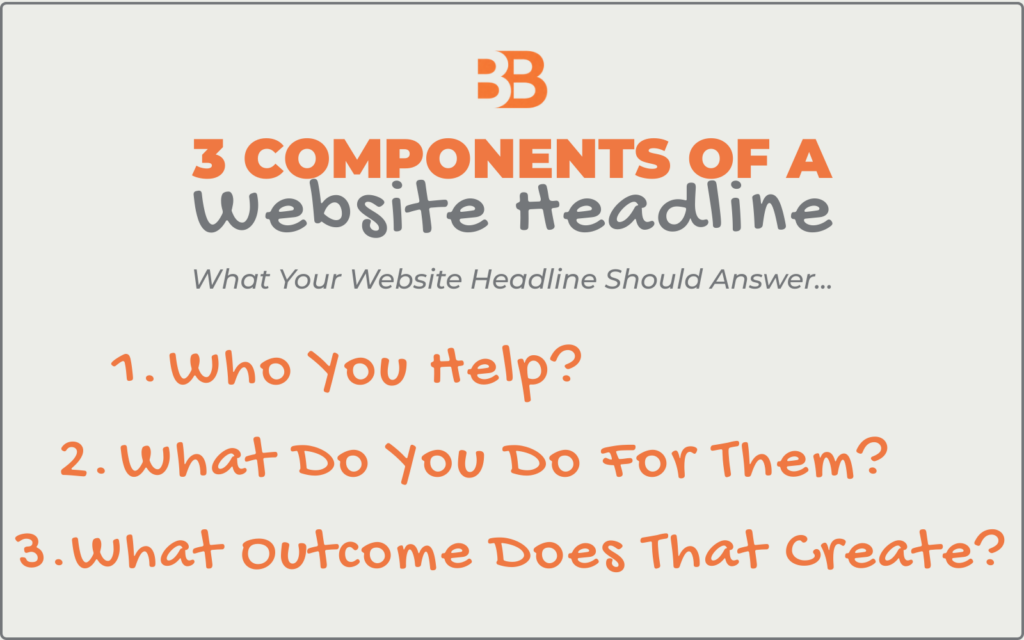
The first question is, who do you help? Be specific. “Small business owners” is better than “everyone.” “Wellness coaches” is better than “small business owners.” The more precisely you name your person, the more that person feels seen when they land on your page.
The second question is, what do you do for them? Name the thing you actually deliver: a website, a brand, a booking system, a strategy. Don’t use vague language like “solutions” or “services.” Be literal and concrete.
The third question is what outcome does that create? This is the part most headlines leave out entirely, and it’s often the most powerful part. The outcome is what your client actually wants: more bookings, more clients, more confidence, more visibility. Lead with the result, and you immediately speak to what your visitor is already hoping for.
Put those three together, and you have the foundation of a strong homepage headline every time.
Website Headline Examples: The Good, The Bad, and The Fix
Let’s look at how this plays out in the real world using wellness coaches as the example, because this is one of the industries where homepage headlines tend to be the vaguest and the most generic.

Hero Text Example # 1
Poor headline: “Welcome to Bloom Wellness.”
- This headline says nothing. It names the business but gives the visitor zero reason to stay.
- It answers none of the three questions and could belong to any business in any industry.
Strong headline: “Helping overwhelmed women find balance through holistic health coaching, so they can feel like themselves again.”
- This headline names exactly who it’s for, what the coach does, and the emotional outcome the client is seeking.
- A woman who feels overwhelmed and out of balance reads this and immediately thinks: This is for me.
Hero Text Example # 2
Poor headline: “Holistic Health and Wellness Services.”
- This is a description, not a headline.
- It’s the kind of copy that gets written when someone isn’t sure what to say, so they just describe what they do in the most generic terms possible.
- It creates no emotional connection and gives the visitor no reason to keep reading.
Strong headline: “Online health coaching for busy moms who want more energy without overhauling their entire life.”
- Specific person: busy moms.
- Specific service: online health coaching.
- Specific outcome: more energy without an overwhelming commitment.
- Every word is earning its place.
Hero Text Example # 3
Poor headline: “Transform Your Life Today.”
- Vague, overused, and completely interchangeable with a thousand other websites in a thousand other industries.
- “Transform your life” could be a gym, a therapist, a financial advisor, or a life coach. It tells the visitor nothing about who specifically can help them or how.
Strong headline: “Gut health coaching for women who’ve tried everything and still don’t feel well.”
- This headline speaks directly to a very specific frustration: the woman who has already tried multiple things and is still struggling.
- That reader doesn’t just feel seen, she feels understood.
- That emotional recognition is what converts a visitor into an inquiry.
How to Write Good Headlines (Step by Step)
Here is a simple formula you can use right now to write or rewrite your homepage headline. Fill in each blank as specifically as possible. The more specific you are, the stronger your headline will be.
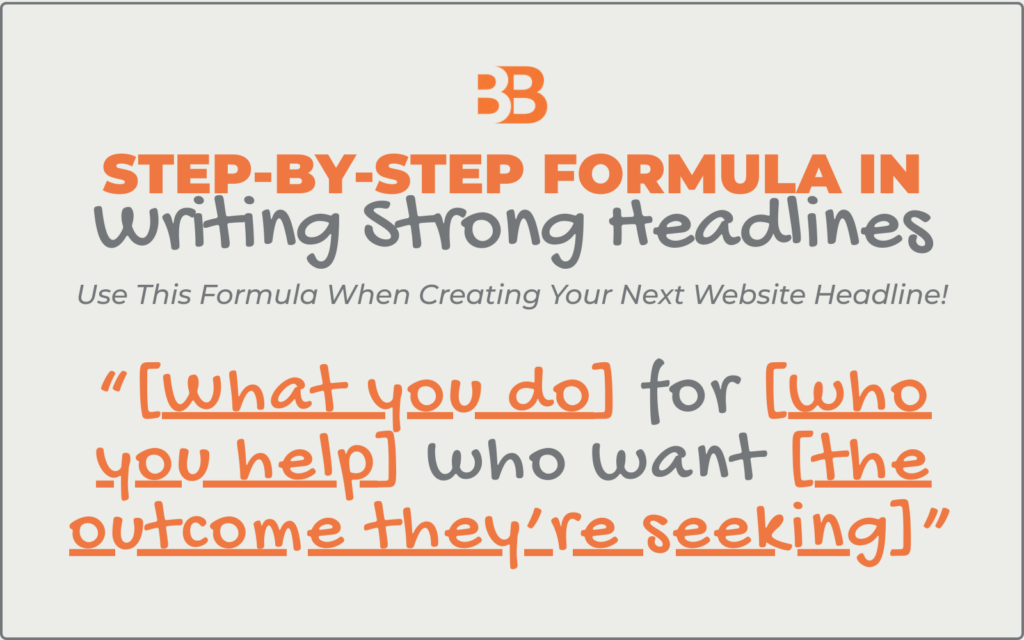
The Formula: “[What you do] for [who you help] who want [the outcome they’re seeking].”
Alternatively: “Helping [who you help] [achieve outcome] through [what you do].”
Work through it like this. First, write down the most specific description of your ideal client you can, not just “women” or “business owners,” but the specific version of that person with the specific problem you solve best. Then write down the one thing you deliver. Then write down the result that thing creates in their life or business.
Put those three pieces together, read it out loud, and ask yourself honestly: if my ideal client landed on my homepage right now and read this, would they immediately feel like this was written for them? If the answer is yes, you have your headline. If there’s any hesitation, keep refining.
Common Headline Mistakes to Avoid
Even with the formula in hand, there are a few traps that are easy to fall into. Here are the most common ones worth watching out for.
Leading with your business name. Your business name belongs in your logo, not your headline. Visitors can see your name, but what they need to know immediately is whether you can help them.
Being vague to appeal to everyone. The instinct to keep your headline broad so you don’t exclude anyone actually has the opposite effect: it resonates with no one in particular, which means it converts almost no one. Specificity is what creates connection.
Using industry jargon. Words like “holistic solutions,” “transformative experiences,” or “integrative wellness” mean something to you but often mean very little to the person reading your homepage for the first time. Write the way your clients actually talk about their problems, not the way your industry talks about your services.
Writing for yourself instead of your visitor. If your headline focuses on how long you’ve been in business, your credentials, or your philosophy, you’re writing for yourself. Your visitor’s first question is not “who are you?” — it’s “can you help me?” Answer that question first.
Forgetting the outcome. Features tell, outcomes sell. “Health coaching packages” is a feature. “Finally feeling like yourself again” is an outcome. Lead with what your client gets, not with what you offer.
Closing Thoughts and Suggestions
Your homepage headline is not set in stone the moment you write it. The best approach is to treat it as a living piece of copy that you revisit and refine as you learn more about your clients and what language resonates with them.
If you went through this post and realized your current headline needs work, here are three simple steps to start with today:
Step 1: Audit Your Current Headline
Go to your homepage right now and read your headline as if you’re a first-time visitor who knows nothing about you. Does it clearly tell you who this site is for and what they’ll get? If not, write down what’s missing.
Step 2: Write Three New Versions Using the Formula
Don’t aim for perfect on the first try. Write three different versions using the formula above: different angles, different outcomes, different levels of specificity. Then read each one out loud and notice which one feels most like something your ideal client would respond to.
Step 3: Ask Someone Outside Your Industry to Read It
Share your top headline with a friend, family member, or past client who isn’t in your field and ask them: Does this tell you clearly who this is for and what they’ll get? Their immediate reaction will tell you everything you need to know about whether it’s working.
These three steps take less than an hour and could be the single most impactful thing you do for your website this month.
Want to go deeper on what your website needs to attract and convert clients consistently? Start with the full Small Business Website Checklist: 9 Things Your Site Needs to Get Clients and work through each point one at a time.


